When homeowners, builders and architects compare window quotations, the lowest rate per square foot often looks like the best deal. But a window is not just a frame and glass. It is a long-term building component that must handle wind, rain, dust, heat, noise, daily operation and years of exposure.
A cheap window may save money on day one, but it can lead to air leakage, water seepage, rattling, difficult operation, poor sound insulation, hardware failure and repeated service visits. In extreme weather, poor specification or installation can even create safety risks.
Before selecting any window system, ask a simple question: Is it engineered, manufactured and installed according to recognised Indian Standards and site-specific requirements?
Why “Cheap” Often Becomes Expensive
Low-cost quotations may reduce cost in areas that are not immediately visible:
- Thinner or lower-quality profiles
- Inadequate reinforcement for large openings
- Basic hardware instead of suitable multipoint systems
- Poor gaskets, seals and drainage detailing
- Inaccurate fabrication
- Weak installation and fixing methods
- No proper performance validation
The result may be a window that looks acceptable at handover but fails during monsoon, dust storms, high winds or regular use.
A window should always be evaluated on complete value — profile quality, hardware, glazing, fabrication, installation, performance and after-sales support — not only on its initial price.
A Real Warning from Noida
In May 2025, a severe dust storm swept through Delhi-NCR. At Jaypee Aman Society in Noida’s Sector 151, multiple news reports stated that windows and doors were blown out in several apartments. Broken frames, damaged doors and debris were seen across the complex, while residents also reported AC units falling from building exteriors. Residents alleged substandard construction and demanded a structural audit.
The India Meteorological Department reportedly recorded wind speeds of around 40–50 km/h in the affected NCR area. Whether each individual failure was caused by window design, installation, structural detailing, maintenance or extreme wind pressure would require technical investigation. But the incident is a clear reminder that windows and doors are safety-critical components, not decorative items.
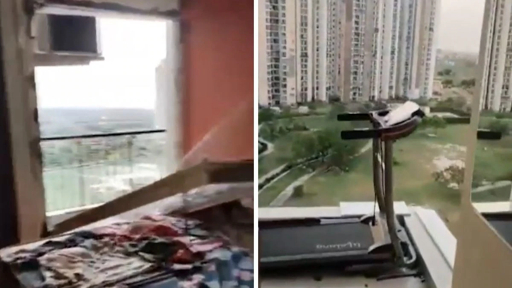
Similar damage was reported in Greater Noida West’s Ajnara Homes, where falling plaster damaged a vehicle. News coverage also highlighted the pressure that storms place on windows and doors, reinforcing the need for proper design, material selection and inspection.
What Buyers Should Learn
These incidents do not prove that every failure was caused by a low-cost window. However, they highlight an important lesson for every homeowner, builder and architect:
- Windows must be engineered for the building’s wind exposure and floor height.
- Large openings require correct reinforcement, fixing and glazing design.
- Installation quality is as important as the window system itself.
- Hardware, seals, gaskets and drainage must suit Indian weather conditions.
- Compliance with applicable Indian Standards should be verified, not assumed.
Standards Every Buyer Should Know
For Aluminium Windows and Doors
For aluminium-framed doors, windows and sliders, the relevant Indian Standard is IS 1948:2024 — Aluminium Framed Doors, Windows and Sliders — Specification.
This standard covers material quality, fabrication, performance and testing requirements for aluminium fenestration systems. It is an official Indian Standard established by the Bureau of Indian Standards and notified in the Gazette of India.
For buyers, this means an aluminium window should not be selected only for its appearance or rate. It should be checked for profile quality, fabrication accuracy, hardware, glazing, weather performance, structural performance and installation detailing.
For uPVC Windows and Doors
For uPVC systems, profile quality is covered by IS 17953:2023 — uPVC Profiles for Windows and Doors — Specification.
This standard specifies requirements for uPVC profiles, including material, dimensions, physical properties and performance testing. It covers aspects such as impact resistance, heat reversion, weathering performance and weldability.
The profile is the foundation of a uPVC window. If the profile is weak, poorly formulated or inconsistently manufactured, even good glass or hardware cannot fully compensate.
Large Windows Need Engineering, Not Assumptions
Indian Standards do not provide a universal maximum-size chart for uPVC windows and doors. Large openings must be engineered based on the system supplier’s tested design, reinforcement details, wind-load calculation, glazing weight and manufacturer guidelines.
This is why a large window cannot be selected only by comparing quotations. The supplier must confirm whether the proposed size, opening type, reinforcement, hardware and installation method are technically suitable for the project.
For example, a tall 2.7-metre-high opening cannot be treated in the same way as a standard residential window. It may require additional reinforcement, revised divisions, stronger hardware and a carefully designed fixing system.
Questions to Ask Before Buying
Before finalising any window order, ask the supplier:
- Which Indian Standard does the system comply with?
- Is the uPVC profile BIS-certified under IS 17953:2023?
- What reinforcement is being used for large openings?
- What hardware is included, and is it suitable for the size and usage?
- Has the system been tested for air tightness, water tightness and structural performance?
- What glass specification is being offered?
- How will the window perform under local wind load and weather conditions?
- What installation detailing is included?
- What warranty is provided on profiles, hardware, glass and installation?
- What happens if the opening size or configuration changes during execution?
A professional supplier will answer these questions clearly. A supplier offering only the lowest price may avoid them.
Price Versus Value
| Factor | Cheap Window Approach | Standard-Compliant Approach |
|---|---|---|
| Initial cost | Lower | May be higher |
| Profile quality | Often uncertain | Defined by applicable Indian Standard |
| Hardware | Basic or unspecified | Selected for size, usage and performance |
| Large openings | May be unsupported | Engineered with correct reinforcement |
| Water and air leakage | Higher risk | Designed and tested for performance |
| Service issues | More likely | Reduced through correct specification |
| Long-term value | Poor | Better |
The real cost of a window is not its purchase price. It includes installation, maintenance, repairs, energy loss, inconvenience and possible replacement over its life.
Final Advice
Do not buy a window only because it is cheap.
Buy a window because it is:
- Correctly engineered for the opening size
- Made from quality profiles
- Fitted with appropriate hardware
- Installed with proper detailing
- Supported by applicable Indian Standards
- Backed by a responsible supplier
A window is a long-term investment in comfort, safety and building performance. Choosing only on price is often the most expensive decision a buyer can make.

No comments:
Post a Comment